 (406) 453-7000


 (406) 453-7000
If you own or manage a commercial building in North Central Montana, you already know that the weather here doesn’t mess around. We’re talking about winters that snap into single digits overnight, spring thaws that can dump inches of water in a matter of days, summer sun that bakes everything it touches, and wind that seems to have a personal grudge against anything attached to a rooftop. Your commercial roof takes all of that — every single day, year after year — without a break and without a complaint. Until it can’t anymore.
The problem is that most commercial roof damage doesn’t announce itself. It builds slowly, season by season, until a small issue becomes a costly one. Understanding how weather affects your commercial roof over time isn’t just interesting information — it’s the difference between a well-maintained asset and an unexpected capital expense that nobody budgeted for.
Quick Takeaways
- Montana’s seasonal extremes create compounding stress on commercial roofing systems
- Freeze-thaw cycles are among the most destructive forces a flat or low-slope roof can face
- UV exposure degrades roofing membranes gradually, long before visible damage appears
- Wind uplift and storm events can compromise roof integrity without obvious exterior damage
- Proactive inspections and maintenance cost a fraction of emergency repairs or full replacement
What Makes Montana Weather So Hard on Commercial Roofs Specifically?
It’s not one thing — it’s everything, cycling back and forth all year long.
Commercial roofs, particularly flat and low-slope designs common on warehouses, retail buildings, and industrial facilities, face a different set of challenges than steep residential roofs. Water doesn’t shed as quickly. Membranes expand and contract with temperature. Seams, flashings, and penetrations are exposed to stress from multiple directions simultaneously.
In Montana, those challenges are amplified by the sheer range of conditions your roof experiences across a single year. According to NOAA’s climate data for Montana, the state regularly sees temperature swings of 50 degrees or more between seasons — and sometimes between days. That kind of thermal cycling is relentless on roofing materials, and it’s one of the primary reasons commercial roofs in this region age faster than national averages would suggest.
How Does Freezing and Thawing Damage a Commercial Roof Over Time?
Slowly, silently, and more thoroughly than most building owners realize.
Freeze-thaw cycles are the quiet killers of commercial roofing systems. Here’s how it works: water — from rain, snowmelt, or condensation — finds its way into a tiny crack, a slightly lifted seam, or a gap around a rooftop penetration. Temperatures drop, that water freezes, and as it expands, it widens the opening. Temperatures rise, it melts and drains, and the opening is now a little bigger than before. This cycle repeats dozens of times each winter.
Over a few seasons, those micro-openings become pathways. Water that was once deflected now infiltrates the membrane, the insulation beneath it, and eventually the decking. By the time a leak shows up on a ceiling tile inside your building, the damage above has typically been underway for months — sometimes longer.
The flashings around HVAC units, skylights, drains, and parapet walls are especially vulnerable to this process. These transition points are already under mechanical stress, and freeze-thaw expansion makes that stress cumulative. Our commercial roofing services are specifically designed to address these high-risk areas with materials and installation methods built for Montana conditions.
What Does Sun and Heat Do to a Commercial Roofing Membrane?
More than you’d expect — especially at elevation, where UV intensity is higher.
Montana’s summer sun hits commercial roofing membranes hard. UV radiation breaks down the chemical bonds in roofing materials over time, causing them to dry out, become brittle, and lose their flexibility. A membrane that was once capable of stretching and moving with the building becomes stiff and prone to cracking — which creates exactly the kind of openings that freeze-thaw cycles then exploit.
Thermal shock is another piece of this. On a clear summer day, a dark commercial roofing membrane can reach surface temperatures well above 150°F. When an afternoon thunderstorm rolls through and drops that temperature by 40 degrees in a matter of minutes, the rapid contraction puts enormous stress on seams and attachment points. Do that repeatedly across a Montana summer, and you’re accelerating the aging process significantly.
Reflective coatings and cool-roof membranes can help reduce this thermal load, which is worth discussing with a qualified contractor when your roof is due for maintenance or replacement.
How Do Wind and Storms Affect Commercial Roof Performance?
The damage isn’t always visible from the ground — and that’s what makes it dangerous.
Wind is one of the most underestimated threats to commercial roofing systems. High winds create uplift pressure — essentially pulling the roof membrane upward at its edges, corners, and seams. Even if the membrane stays in place, repeated uplift stress weakens the adhesion and fastening systems beneath it. Over time, this leads to membrane displacement, open seams, and in severe cases, partial blow-off.
Montana’s wind events — particularly the chinooks that move through the region — can be sudden and intense. Here are the areas most commonly compromised after a significant wind event:
- Perimeter edges and corners, where uplift forces are strongest
- Roof-to-wall flashings and parapet caps
- Membrane seams that weren’t fully adhered during installation
- HVAC curbs and other rooftop equipment penetrations
- Drains and scuppers that may shift or loosen under wind pressure
The frustrating reality is that much of this damage isn’t obvious from street level. The roof looks intact, business continues as normal, and the underlying compromise quietly allows moisture in with each subsequent rain event. That’s why a post-storm inspection matters so much — not just for visible damage, but for the structural integrity of the whole system. If your building has recently been through a significant weather event, our storm damage repair team can assess what’s going on and get it handled fast.
What Role Does Moisture and Standing Water Play in Commercial Roof Deterioration?
On a flat roof, water that has nowhere to go becomes your biggest liability.
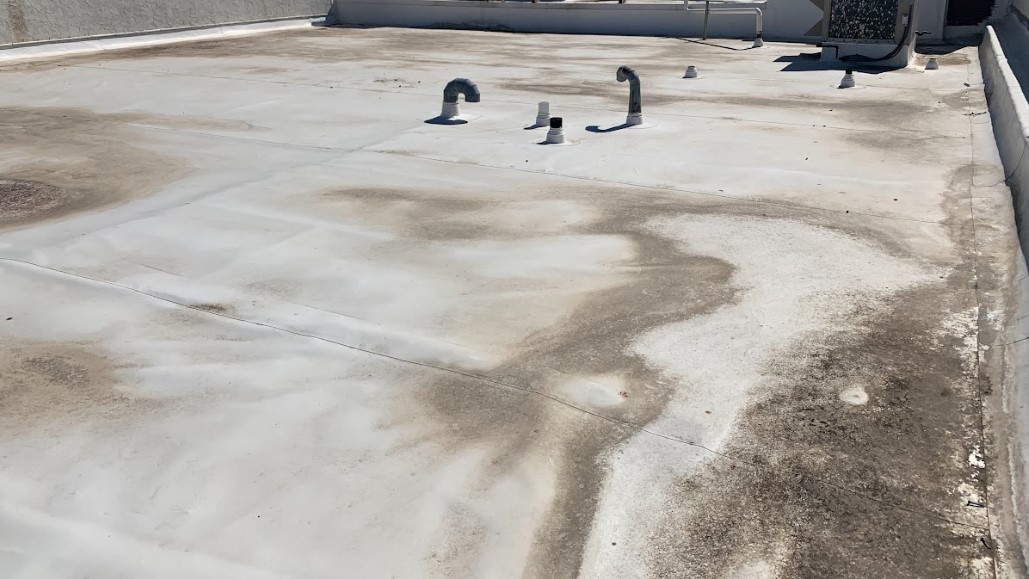
Flat and low-slope commercial roofs are designed to drain — but over time, settling, debris accumulation, and drain blockage can create areas where water pools after a rain event. This is called ponding water, and it’s a serious problem. The National Roofing Contractors Association identifies ponding water as one of the leading accelerators of commercial roof membrane deterioration.
Standing water adds weight to the roof structure, promotes algae and vegetation growth, and keeps the membrane in a state of constant saturation. Saturated membranes are softer, more vulnerable to foot traffic damage, and more susceptible to UV degradation when they do dry out. Over multiple seasons, ponding water can compromise both the roofing system and the structural deck beneath it.
Regular drain cleaning, slope correction, and tapered insulation systems are all practical solutions depending on your building’s configuration. Keeping your drainage system clear and functional is one of the simplest — and most cost-effective — things a commercial property owner can do to extend roof life.
Real Questions, Straight Answers: What Commercial Building Owners Ask Us Most
How often should a commercial roof be professionally inspected?
Twice a year is the standard recommendation — once in spring after winter weather has run its course, and once in fall before the next freeze cycle begins. Additionally, any significant storm event warrants a follow-up inspection regardless of where you are in the calendar. Catching post-storm damage early is almost always less expensive than discovering it after the next rain.
How long should a commercial roof last in Montana’s climate?
It depends on the system. A quality TPO or EPDM membrane installed correctly can last 20 to 30 years with proper maintenance. Modified bitumen systems typically land in the 15 to 25 year range. However, deferred maintenance and Montana’s climate extremes can cut those numbers significantly. Regular upkeep is what keeps you on the longer end of the range.
Can a commercial roof be repaired, or does weather damage always mean full replacement?
Most weather-related damage — compromised seams, flashing failures, localized membrane deterioration — can be repaired if caught early. Full replacement becomes necessary when damage is widespread, when the insulation is saturated, or when the membrane has reached the end of its serviceable life. A thorough inspection by an experienced contractor will tell you exactly where you stand.
What’s the most cost-effective thing I can do to protect my commercial roof right now?
Schedule an inspection. Seriously. The cost of a professional roof assessment is negligible compared to what deferred maintenance tends to produce. Most building owners who invest in regular inspections and minor repairs extend their roof’s life by years — sometimes decades — and avoid the kind of emergency situations that disrupt business operations and drain capital budgets.
Weather Will Keep Coming — Make Sure Your Roof Is Ready for It
Montana weather isn’t going to ease up. The winters will keep cycling through freeze and thaw, the summer sun will keep working on your membrane, and the wind will keep testing every edge and seam. That’s just the reality of doing business here. But the damage that weather causes isn’t inevitable — not when you have the right team maintaining your roof and catching problems before they compound.
At A-1 Contractors, Inc., we’ve been protecting commercial and residential properties across North Central Montana since 2006. We’re a GAF Master Elite certified contractor, which means we’ve met the highest standards in the roofing industry — and we bring that standard to every commercial project we touch. We know this climate, we know these roofing systems, and we know what it takes to keep them performing year after year.
Don’t wait for a leak to tell you something’s wrong. Get ahead of it. Contact A-1 Contractors, Inc. today to schedule your commercial roof inspection or request a free estimate. Call us directly at (406) 453-7000. Your building depends on that roof. Make sure it’s in the hands of people who take that seriously.